
Retrieval-augmented generation has moved from flashy demos to live deployments across hospitals, payers, and life-sciences teams. Yet a chatbot that dazzles in a pilot can fail dangerously at the bedside. Building production-grade RAG for high-stakes healthcare is less about a clever prompt and more about engineering discipline. Two principles separate a safe clinical system from a liability. The first is guardrails that constrain what the model can say. The second is determinism that makes its behavior reproducible and auditable. This guide explains how to architect both, and why they matter when lives and compliance are on the line.

Why “Good Enough” AI Breaks in Healthcare
In most industries, an occasional wrong answer is an annoyance. In medicine, it can change a diagnosis or a dose. That is why the bar for healthcare AI is so much higher.
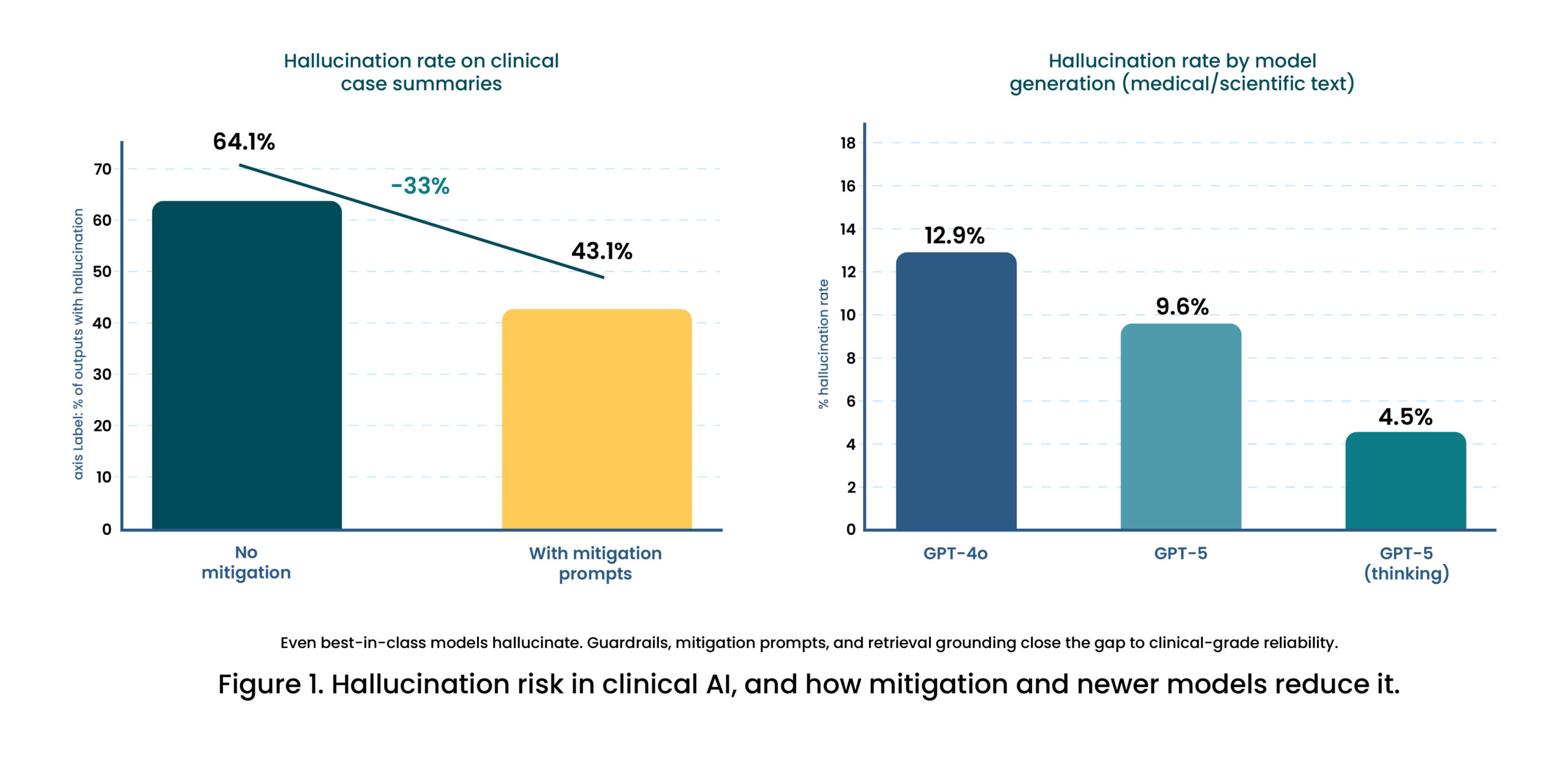
The risk is not hypothetical. Studies show state-of-the-art medical LLMs hallucinate on 15–40% of clinical tasks. A 2025 analysis found hallucination rates on clinical case summaries reached 64.1% without mitigation, falling to 43.1% with structured prompts. Even newer models are imperfect: GPT-5 hallucinates on roughly 9.6% of medical and scientific text, down from 12.9% for its predecessor.
The takeaway is simple. You cannot trust a base model alone in a clinical setting. Production-grade RAG closes that gap by grounding answers in verified sources and wrapping the model in controls.
What “Production-Grade RAG” Really Means
A RAG pipeline retrieves relevant documents, such as a patient chart, drug monograph, or clinical guideline, and feeds them to the model before it answers. This grounds the output in evidence rather than the model’s memory.
Production-grade RAG goes further than a working prototype. A RAG system is ready for high-stakes healthcare only when it is:
- Grounded: every claim traces back to a retrieved, citable source.
- Governed: prompts, models, and data are versioned and access-controlled.
- Monitored: quality, drift, and safety are measured continuously.
- Reproducible: the same question yields consistent, defensible answers.
Guardrails: A Layered Defense
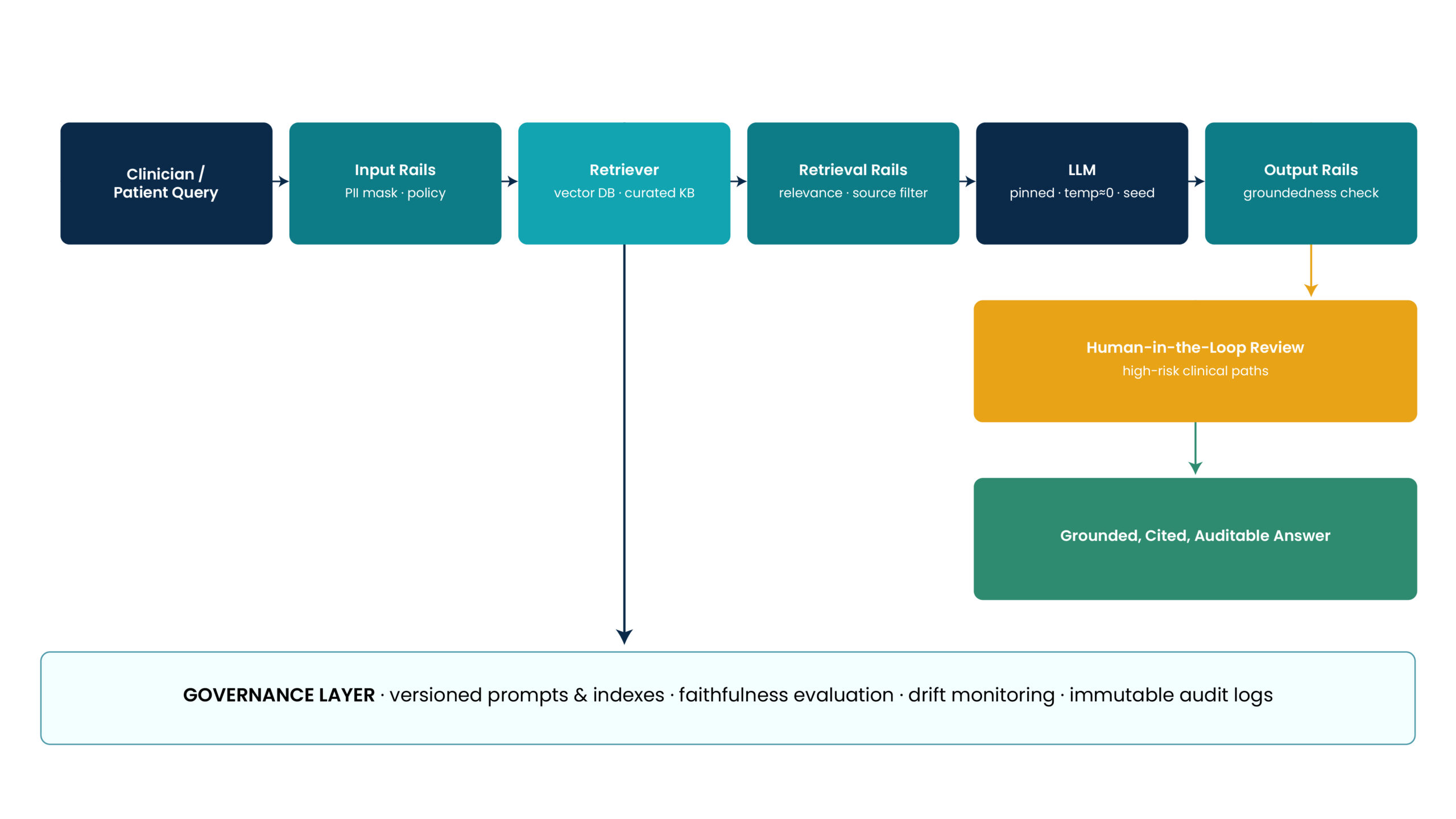
Guardrails are the policies and mechanisms that constrain model behavior and enforce verifiable outputs. The most reliable approach is layered, applying checks at each stage of the RAG pipeline. Frameworks such as NVIDIA NeMo Guardrails formalize these layers.
- Input rails screen the user’s query first. They can mask protected health information, block off-topic or unsafe requests, and confirm intent before anything reaches the model.
- Retrieval rails inspect the documents the system pulls. A retrieval rail can reject low-relevance chunks or untrusted sources, so the model never reasons over bad evidence.
- Output rails check the answer before it is shown. They run fact-checking and groundedness tests, ensuring each statement is supported by the retrieved context.
- Human-in-the-loop review is the final layer for high-risk paths. For clinical, legal, or safety-critical outputs, a qualified human verifies the response.
Together, these rails turn an open-ended model into a constrained, defensible system.
Determinism: Engineering Reproducible Outputs
A regulator or clinician will eventually ask a fair question: “If I run this again, will I get the same answer?” For standard generative AI, the honest answer is often no. The same input can produce ten different outputs, which is a barrier to auditability.
Lowering the sampling temperature toward zero is the first step, and RAG systems often run at 0.0–0.3 for consistency. But temperature alone is not enough. Even at zero, most production APIs do not guarantee bit-exact results, because batch-size-dependent floating-point math yields roughly 95–99% identical outputs, not 100%.
True determinism in production-grade RAG therefore comes from disciplined engineering:
- Pin everything: lock model versions, prompt templates, and retrieval index snapshots so nothing shifts silently.
- Fix the randomness: set low temperature and fixed seeds where the platform supports them.
- Snapshot the knowledge base: record exactly which documents were retrieved for each answer.
- Log immutably: capture inputs, sources, and outputs so any response can be reconstructed and audited later.
The goal is not philosophical perfection. It is a system whose answers you can explain, defend, and reproduce on demand.
Evaluate What You Can Audit
You cannot manage what you do not measure. Mature teams evaluate RAG quality with dedicated metrics rather than gut feel. Frameworks like RAGAS focus on the signals that matter most in healthcare:
- Faithfulness (groundedness): is every claim supported by the retrieved evidence? This is the single most important metric for clinical use.
- Context precision and recall: did the retriever surface the right documents, and all of them?
- Answer relevancy: does the response actually address the question asked?
Pair these with continuous drift monitoring. Models, data, and usage patterns change, and a system that was safe last quarter may degrade quietly. Ongoing evaluation catches that before patients do.
Compliance by Design
In healthcare, RAG architecture and regulation are inseparable. HIPAA governs how patient data is handled. Separately, the FDA treats many clinical decision support tools as Software as a Medical Device, using a total-product-lifecycle approach. As of mid-2025, the FDA had authorized more than 1,250 AI-enabled medical devices, and its scrutiny of generative AI is intensifying.
Designing guardrails, determinism, audit logs, and human oversight from day one is not bureaucratic overhead. It is what makes a system deployable, defensible, and trustworthy.
The Bottom Line
Production-grade RAG in high-stakes healthcare is an exercise in engineered trust. Guardrails decide what the model can say; determinism ensures it says the same thing reliably; evaluation and compliance prove it. Get these right, and retrieval-augmented generation becomes not just impressive, but safe enough for the clinic.
Ready to architect RAG you can trust? Talk to the Healthark team to design guardrailed, audit-ready AI for your highest-stakes healthcare workflows.
Insights That Drive Impact
Healthcare is evolving faster than ever — and those who adapt are the ones who will lead the change.
Stay ahead of the curve with our in-depth insights, expert perspectives, and a strategic lens on what’s next for the industry.