

In recent years, multi-agent systems (MAS) have evolved from isolated intelligent entities into complex networks of collaboration powering robotic fleets, distributed simulations, and AI agents capable of reasoning together. Each agent contributes specialized capabilities, yet their true potential emerges only when they coordinate effectively, exchanging context and responsibilities in real time.
As these systems scale, orchestration becomes the defining challenge. Static workflows or simple message passing can no longer capture the fluidity of interactions among autonomous agents. Modern deployments demand adaptive mechanisms that can manage session handoffs, dynamic task dependencies, and fault recovery without central supervision.
To meet these demands, new frameworks such as LangGraph and the Multi-Context Protocol (MCP) are redefining how multi-agent coordination is structured.
Challenge: Rethinking Multi-Agent Systems for Scalable, Adaptive Collaboration
Traditional multi-agent systems (MAS) rely on autonomous agents with fixed roles and rigid coordination protocols like the Contract Net Protocol (CNP). Frameworks such as JADE and standards from FIPA have enabled structured communication and task allocation across domains like sensor networks, robotics, and distributed manufacturing.
However, these systems face growing limitations:
- Static architectures hinder adaptability in dynamic environments.
- Predefined roles and hierarchies restrict flexible task negotiation.
- Scalability bottlenecks emerge in context sharing and fault recovery
- Maintaining shared state across agents becomes increasingly complex
- Partial failures and evolving objectives are hard to manage without manual intervention
As MAS deployments expand in scope and complexity, there’s an urgent need for more flexible orchestration layers that support open-ended reasoning and dynamic collaboration.
Hence the limitation led to LLM-centric orchestration architectures with frameworks like LangGraph defining dynamic task graphs and protocols such as MCP enabling cross-agent context exchange. These systems allow agents to negotiate, replan, and restore state through structured, language-based communication.
How Frameworks Like Langraph and MCP Redefine Multi-Agent Collaboration
LangGraph provides graph-first orchestration primitives (stateful nodes, cyclical workflows, runtime graph mutation) while MCP provides a standardized semantic transport for sharing rich context and tools across agents; together they enable dynamic, language-native, recoverable multi-agent workflows that behave very differently from classic static MAS.
Core Building Blocks
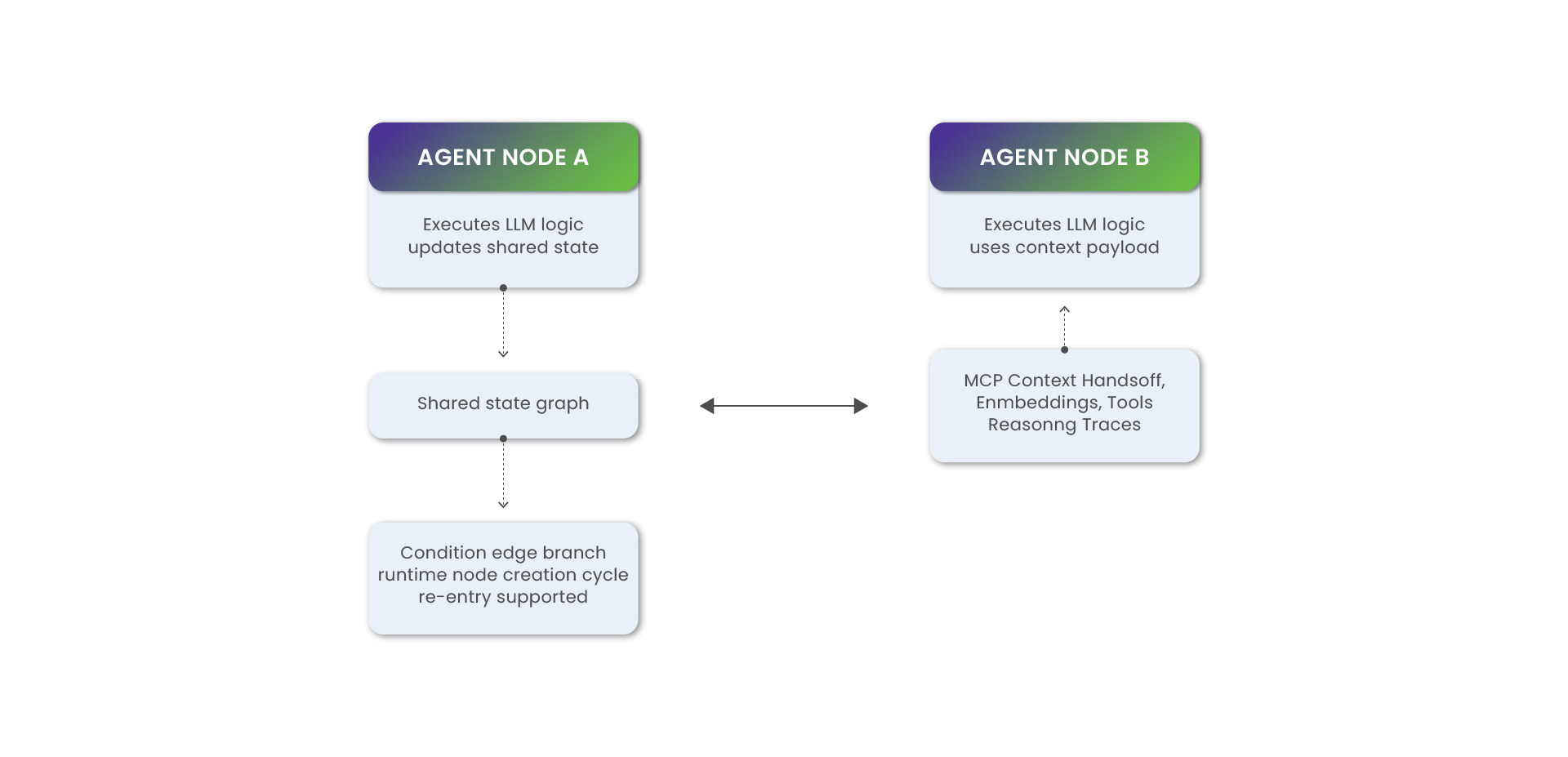
LangGraph – Graph & State Primitives LangGraph structures workflows as explicit graphs (StateGraph with nodes and edges). Each node represents an LLM-executable unit or agent behavior, updating a shared state object. It supports cycles, conditional edges, runtime node creation, and re-entry enabling iterative reasoning and dynamic orchestration.
from langgraph.graph import StateGraph, START, END
builder = StateGraph(StateSchema)
builder.add_node("nodeA", funcA)
builder.add_edge(START, "nodeA")
# optionally, add conditional edges
graph = builder.compile(...)x
Graph Workflow & Multi-Agent Coordination
In LangGraph, each agent is modeled as a node (or group of nodes), with edges representing control flow, data handoff, or agent invocation. The graph can dynamically spawn nodes or restructure edges, enabling adaptive coordination. For example, an agent detecting missing context can trigger a sub-agent, redirect flow for verification, then resume the main path. A shared state object carries context (messages, tool outputs, embeddings), ensuring consistent memory across agents not isolated per node.
MCP
Standardized Context & Tool ProtocolMCP (Model Context Protocol) is an open standard that defines how applications provide tools and context to language models. Agents in LangGraph use MCP-compliant adapters (e.g., langchain-mcp-adapters) to invoke tools, access data, and share context in a structured, interoperable way. Architecture Highlights:
- MCP Server exposes tools and data via a standard interface.
- Agents (MCP clients) send requests: invoke(tool_id, arguments, context) and receive structured responses.
- Context payloads include embeddings, reasoning traces, and prior outputs — enabling rich, persistent session handoffs.
This protocolization ensures standardized, implementation-agnostic context transfer between agents, supporting auditability, replay, and seamless coordination.
How this Changes Inter-Agent Coordination (Mechanisms) - Workflow Overview
Explicit, Mutable Workflow Graphs (LangGraph)
Dynamic Topology: LangGraph workflows (via state graph) can dynamically spawn nodes, insert conditional branches, and reconnect edges at runtime. This enables emergent coordination from agent decisions, removing the need for rigid, pre-defined flows.
Cyclic/Iterative Reasoning: Supports cycles and re-entry into prior nodes, enabling multi-step refinement and verification overcoming the limitations of strictly acyclic orchestration.

Agent Definition (LangChain Layer)
Individual agents are defined as LangChain components each encapsulating an LLM, memory, and tools.
from langchain.agents import initialize_agent
planner = initialize_agent(["planning_tool"], llm)
executor = initialize_agent(["action_tool"], llm)
Graph Orchestration (LangGraph Layer)
Agents are registered as nodes in a LangGraph StateGraph, with conditional edges determining control flow.
Each node consumes and updates a shared state object.
graph.add_node("planner", planner)
graph.add_node("executor", executor)
graph.add_edge("planner", "executor", condition="plan_complete")
Context Serialization (MCP Layer)
When the planner node finishes execution, its context (conversation history, plan embeddings, tool outputs) is serialized using MCP.
{
  "context_id": "session_894",
  "state": {"plan": "Optimize inference pipeline"},
  "metadata": {"timestamp": "2025-11-06T14:22Z"}
}
This payload is transmitted to the executor node (local or remote) using MCP’s standardized transport protocol.
Session Handoffs, Replayability & Fault Recovery
- Session Handoff: When control moves from node A to node B, the shared state and MCP payload are passed along, allowing node B to resume reasoning with full context.
- Replayability: Each node updates the state, and MCP logs are captured. This enables snapshotting the graph, state, and messages for deterministic replay useful for debugging, audits, or simulations.
- Fault Recovery: If a node fails or times out, the graph can redirect to fallback nodes. Because context is standardized and shared, recovery is seamless and stateful.
Observability, Serialization & Replay
- Runtime Logs + Snapshots: LangGraph and MCP together enable full serialization of execution including graph structure, node states, edge transitions, and message logs supporting deterministic replay, auditing, and debugging.
- Recoverable Execution: If an agent fails, the system can reassign or replay the node using preserved state and context, enabling graceful failover and robust orchestration - a major leap beyond traditional MAS frameworks.
Distributed Execution
MCP allows nodes in the LangGraph to exist across different runtimes, machines, or even languages (Python, JS, etc.).
LangGraph tracks graph topology and event transitions; MCP ensures each agent receives the exact context snapshot to continue execution seamlessly.
Conclusion
The combination of LangGraph and MCP redefines multi-agent orchestration by merging structured control with contextual intelligence. LangGraph introduces a programmable graph that manages dynamic workflows, state transitions, and recovery, while MCP ensures reliable context transport and synchronization across distributed agents. Together, they enable adaptive, fault-tolerant, and replayable coordination, overcoming the static nature of traditional MAS frameworks. This fusion establishes a foundation for scalable, interpretable, and resilient multi-agent ecosystems, capable of continuous reasoning and collaboration across diverse execution environments.
Curie’s architecture is built on the same foundations outlined above dynamic task graphs, standardized context exchange, and recoverable multi-agent coordination. Instead of isolated LLM calls, Curie uses a graph-driven orchestration layer inspired by LangGraph, where each capability (retrieval, redaction, validation, drafting, summarization, compliance checks, analytics grounding) operates as a specialized agent. These agents update a shared state and trigger downstream agents based on real-time reasoning, allowing Curie to re-route workflows, run iterative verification loops, or invoke sub-agents without predefined rigidity.
Insights That Drive Impact
Healthcare is evolving faster than ever — and those who adapt are the ones who will lead the change.
Stay ahead of the curve with our in-depth insights, expert perspectives, and a strategic lens on what’s next for the industry.